
Myths kill more Python automation dreams than actual difficulty. People convince themselves they’re not smart enough, too old, or lack the right background. They read horror stories about years of study and assume automation is only for “real programmers.”
Most of these beliefs are completely wrong. They persist because they sound reasonable and give people permission not to try. This guide demolishes the ten biggest myths blocking beginners from learning Python automation. Once you see past them, the path forward becomes surprisingly clear. For the practical how-to once you’re ready, this comprehensive Python automation guide walks you through everything step by step.
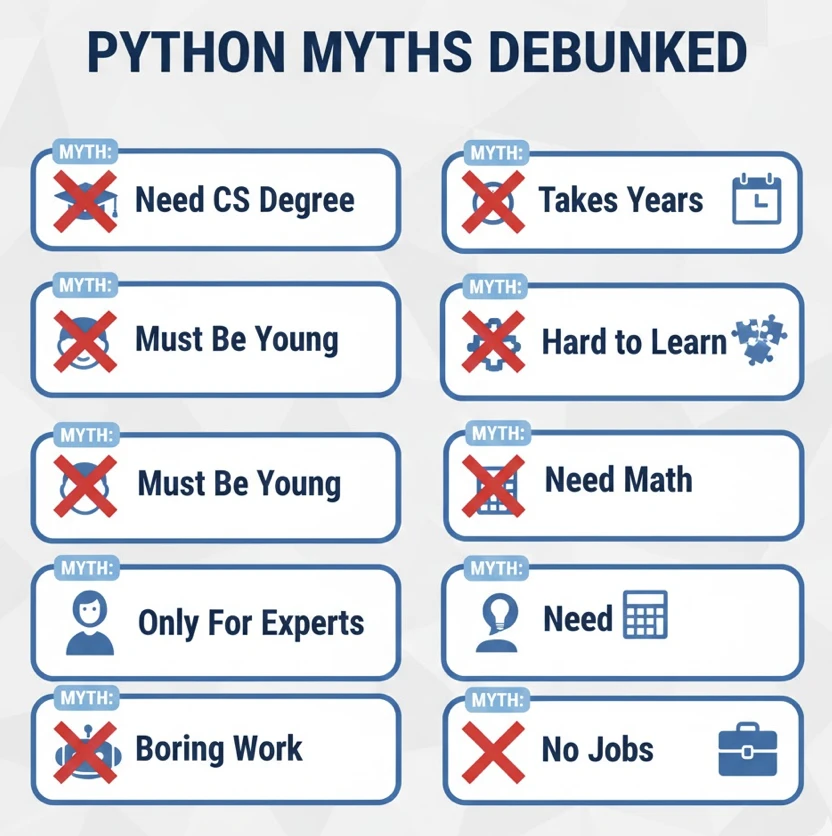
Myth 1: You Need a Computer Science Degree
The myth: Python programming requires formal education in computer science. Without university training, you’ll never truly understand what you’re doing.
The reality: Most Python automation work requires no computer science theory whatsoever. You’re not building operating systems or designing algorithms — you’re automating practical tasks like processing files, cleaning data, and connecting systems.
Thousands of successful automation developers came from completely unrelated fields: marketing, healthcare, finance, teaching. They learned exactly what they needed and skipped everything else. A CS degree teaches many things irrelevant to automation while often neglecting practical skills that matter most.
Myth 2: You Need to Be Good at Math
The myth: Programming is basically math. If you struggled with algebra or calculus, Python will be impossible.
The reality: Python automation requires almost no math beyond basic arithmetic. Can you add, subtract, multiply, and compare numbers? That’s enough for 95% of automation tasks.
You’re not calculating trajectories or solving equations. You’re telling a computer to open this file, find rows matching this condition, and save results here. That’s logic, not mathematics. Many people who “hate math” discover they love programming because it’s a completely different kind of thinking.
Myth 3: You’re Too Old to Start
The myth: Programming is for young people who grew up with computers. If you didn’t start as a teenager, you’ve missed your window.
The reality: Adults often learn programming faster than teenagers. You have advantages young learners lack: clearer goals, better discipline, real problems to solve, and understanding of how businesses work.
People successfully learn Python automation in their 30s, 40s, 50s, and beyond. The brain remains capable of learning new skills throughout life. What matters is consistent practice, not starting age. Your life experience becomes an asset, not a liability.
Myth 4: It Takes Years to Learn
The myth: Becoming proficient in Python requires years of dedicated study before you can do anything useful.
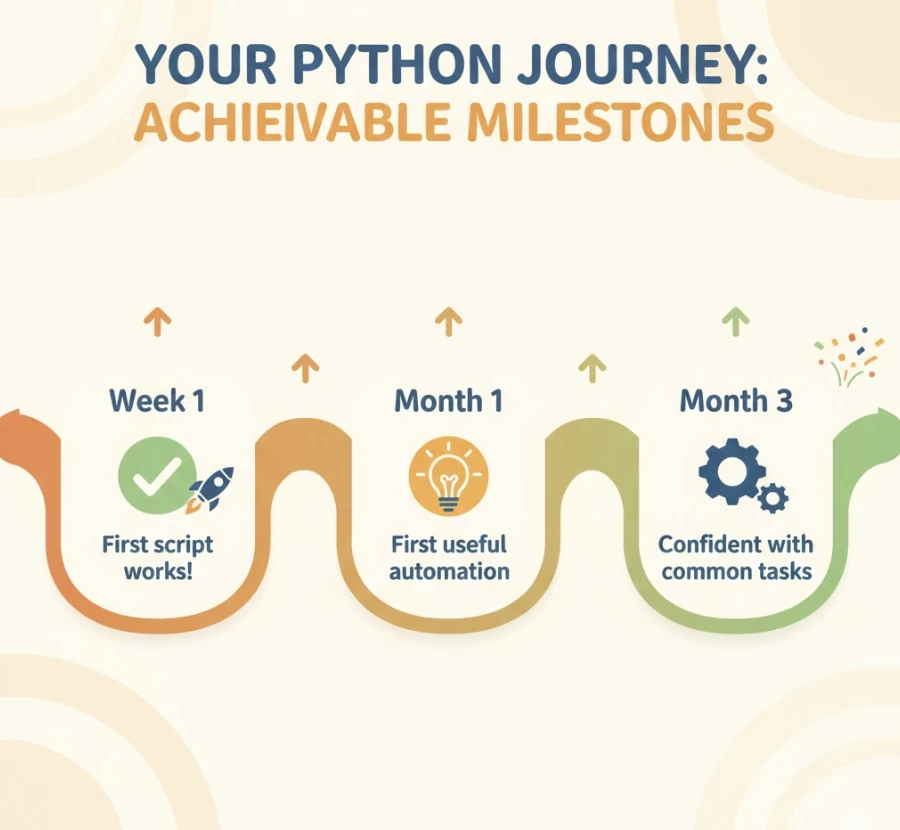
The reality: You can automate meaningful tasks within weeks of starting. Not everything — but real, time-saving automations that deliver immediate value.
Most beginners automate their first useful task within their first month. Within three months of consistent practice, you can handle most common automation scenarios. Yes, mastery takes longer, but usefulness comes quickly. You don’t need years before Python pays off.
Myth 5: You Need to Learn Everything
The myth: Python is huge. You need to master the entire language, all major libraries, and multiple frameworks before you’re ready to build anything real.
The reality: Automation uses a small slice of Python’s capabilities. You need core fundamentals plus a few specific libraries — maybe twenty percent of the language.
Professional automation developers don’t know everything either. They know their domain deeply and look up everything else. Trying to learn all of Python before starting is like memorizing the entire dictionary before writing your first sentence. Learn what you need, when you need it.
Myth 6: Errors Mean You’re Failing
The myth: Good programmers write code that works the first time. If you’re constantly hitting errors, you’re not cut out for this.
The reality: Everyone’s code produces errors constantly. Errors are normal, expected, and educational. Professional developers spend significant time debugging — it’s a core skill, not a sign of incompetence.
Error messages aren’t failures; they’re the computer telling you exactly what went wrong and often how to fix it. Learning to read and resolve errors is itself a valuable skill. The goal isn’t avoiding errors — it’s getting comfortable fixing them.
Myth 7: You Need Expensive Equipment
The myth: Learning Python requires powerful computers, multiple monitors, and specialized hardware.
The reality: Any computer from the last decade can run Python perfectly. Automation scripts are lightweight — they don’t need gaming PCs or workstations.
A basic laptop is plenty. Many people learn on old machines, Chromebooks, or even tablets with keyboard attachments. Python itself is free. Most learning resources are free or inexpensive. The barrier to entry is near zero.
Myth 8: Self-Taught Developers Aren’t Respected
The myth: Without formal credentials, employers won’t take you seriously. Self-taught skills don’t count in the job market.
The reality: Employers care about what you can do, not how you learned it. Your portfolio of working projects matters far more than certificates or degrees.
Many successful developers are entirely self-taught. In automation specifically, demonstrable skills — showing you’ve built things that work — carry more weight than any credential. Companies hire people who can solve their problems, regardless of educational background.
Myth 9: AI Will Make Python Obsolete
The myth: With AI advancing rapidly, learning to code is pointless. AI will write all the code soon anyway.
The reality: AI makes Python skills more valuable, not less. AI tools are powerful assistants, but they require human direction, verification, and integration.
Knowing Python lets you leverage AI tools effectively — you can evaluate AI-generated code, fix its mistakes, and combine it with your own logic. People who understand programming direct AI; people who don’t are limited to hoping AI understands what they want.
Myth 10: You Need Natural Talent
The myth: Some people are born programmers. If coding doesn’t click immediately, you lack the natural ability required.
The reality: Programming is a skill, not a talent. It’s learned through practice, not inherited through genetics.
Everyone struggles at first. The people who seem “naturally talented” usually just started earlier or practiced more consistently. Initial confusion is universal — it doesn’t predict future ability. Persistence matters infinitely more than perceived natural aptitude.
What Actually Matters
Now that myths are cleared away, here’s what genuinely determines success in learning Python automation:
Consistency over intensity: Regular short practice sessions beat occasional marathon sessions. Fifteen minutes daily creates more progress than five hours on weekends.
Application over theory: Learning by doing, not just watching. Every concept should be applied to something real within hours of learning it.
Curiosity over fear: Willingness to experiment, break things, and explore. Asking “what happens if I change this?” accelerates learning dramatically.
Patience over speed: Accepting that confusion is temporary. Skills that seem impossible today become automatic with practice.
Focus over breadth: Going deep on automation-specific skills rather than trying to learn everything Python can do.
The Only Real Requirement
To learn Python automation, you need exactly one thing: willingness to practice consistently for a few months. That’s it. Not talent. Not youth. Not degrees. Not expensive equipment.
The myths exist because they’re comfortable. Believing you can’t learn lets you off the hook for trying. But once you see them for what they are — excuses dressed as facts — the path clears.
Ready to start without the myths holding you back? The Python Automation Course is designed for complete beginners who want practical skills, not gatekeeping. Join thousands who’ve moved past these same myths to build real automation capabilities.