

Data is the backbone of every modern business. Customer records, financial files, project data, employee information — all of it lives digitally. And all of it can disappear in seconds.
Ransomware attacks, hard drive failures, accidental deletions, and natural disasters are not rare events. They happen to businesses of every size, every day. What separates the ones that recover quickly from the ones that don’t isn’t luck. It’s preparation — specifically, whether a reliable backup system was running before the incident occurred.
The Real Cost of Data Loss
Most businesses underestimate how damaging data loss actually is until it happens to them.
According to industry research, the average cost of a data breach for a small or mid-sized business exceeds $120,000. That figure includes downtime, recovery labor, lost revenue, and reputational damage. For many small businesses, a single serious data loss event is enough to force closure.
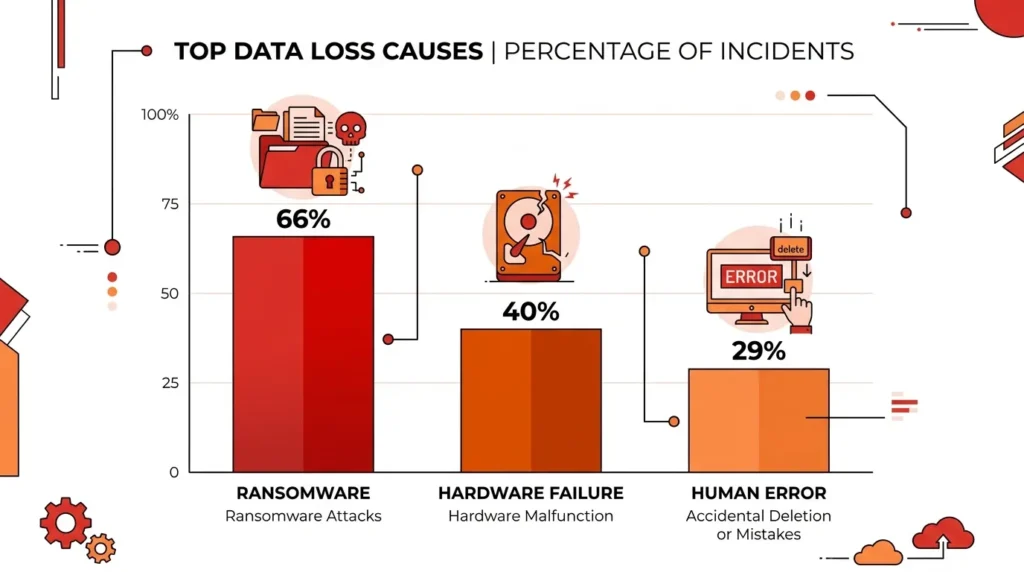
Ransomware alone encrypted data in over 66% of organizations surveyed in 2024. Hardware failure accounts for roughly 40% of all data loss incidents. And human error — accidental deletion, overwriting a file, misconfiguring a system — is behind another 29%.
None of these threats are going away. The only viable response is having a system that captures your data continuously so that when something goes wrong, you’re not starting from zero.
What a Managed Backup Service Actually Does
A managed backup service removes the human element from data protection. Instead of relying on someone to remember to run a backup — or to plug in an external drive — the system handles everything automatically in the background.
The core components of a reliable managed backup solution are:
Automated continuous backups. Data is captured at regular intervals without any manual action required. If a file changes, the updated version is backed up. If a system goes offline unexpectedly, the last backup point is preserved and immediately accessible.
Encrypted offsite storage. Storing backups on the same physical device or network as the original data defeats the purpose. A flood, fire, or ransomware attack that takes out the primary system will take out local backups too. Offsite cloud storage — encrypted end-to-end — keeps backups safe even when the local environment is completely compromised.
Fast, reliable recovery. The value of a backup is measured entirely by how fast and completely you can restore from it. A good managed backup service lets you recover individual files or full system states quickly, with minimal technical complexity.
Business Continuity Is the Real Goal
Data backup is often framed as a security measure. It’s better understood as a business continuity measure.
When a hardware failure takes down a server at 9am on a Monday, the question isn’t “did we have a backup?” — it’s “how fast can we be operational again?” A managed backup service with continuous capture and fast restore means the answer is hours, not days.
Downtime costs businesses an average of $5,600 per minute in lost productivity and revenue at the enterprise level. Even for smaller operations, every hour offline means missed orders, stalled projects, and frustrated clients. Recovery speed is a competitive advantage.
Minimal Setup, Maximum Protection
One reason many small businesses delay implementing a proper backup system is the perceived complexity. Traditional enterprise backup solutions require dedicated IT staff, complex configurations, and ongoing maintenance.
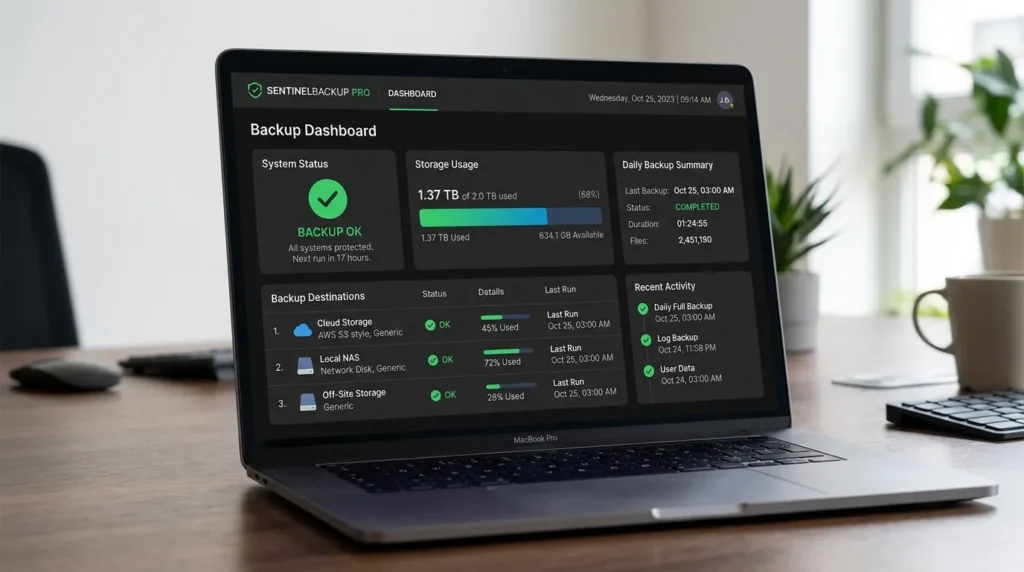
Modern managed backup services have eliminated most of that friction. Platforms like AgooCloud operate as a fully managed backup service — meaning you create an account, install the backup client on your servers or PCs, choose what to protect, and the system handles everything from that point forward. Backups run continuously in the background. No manual intervention. No scheduled reminders. No external drives to manage.
AgooCloud protects servers, desktops, and laptops with end-to-end encryption, storing all data in secure offsite cloud infrastructure. Storage scales with your needs at a flat $60 per terabyte — no complicated tier structures or surprise fees. For businesses that need a quick, credible solution without hiring an IT team to manage it, that kind of simplicity matters.
What to Look for in a Backup Solution
Not all backup services are equal. Before choosing one, verify these four things:
Encryption at every stage. Data should be encrypted before it leaves your device and remain encrypted in storage. End-to-end encryption means even the provider cannot access your files.
Automated scheduling with version history. A backup that runs once a day leaves a 23-hour gap. Continuous or frequent automated backups, combined with version history (so you can restore a file from last Tuesday, not just last night), gives you genuine protection.
Offsite storage. Your backup must be physically and logically separate from your primary systems. Cloud-based offsite storage is the standard for good reason.
Scalability. Your backup needs will grow as your business grows. Choose a provider that scales storage transparently without forcing you to migrate to a new plan every six months.
Data Protection Is Not Optional Anymore
Cybersecurity regulations in the EU, UK, and US increasingly require businesses to demonstrate data protection practices — not just claim them. Beyond compliance, clients and partners are scrutinizing data handling practices more carefully than ever.
A managed backup service is the foundation of that protection. It closes the most common failure point in business continuity planning — the gap between knowing you should back up your data and actually having a system that does it reliably, automatically, and without depending on anyone remembering to press a button.
The cost of setting one up is a fraction of what a single data loss event will cost you.